Within this document, I will be looking at the importance of health and safety at a live music event as well as different health and safety procedures, readying myself to be able to but on my own live music event.
Health and safety planning and delivery is important both before and during the event to keep everyone safe and healthy, as Hse.gov.uk (n.d, n.p) suggests:
“Good planning and organisation is essential to putting on an event that is both safe and enjoyable.”
This source is from a branch of the Government’s website, which is dedicated to providing information about event health and safety. This source is primary, this makes it reliable to my research.
How are risks assessed, managed and documented?
Considering key risks when planning an event is a very important task, other risks such as more major incidents, as well as other situations suggested by Hse.gov.uk (n.d,n.p) such as:
“An entertainment act cancelling at short notice, severe weather or unavailability of key staff”,
Must be thought about and planned for to prevent any problems concerned with the event.
Risk assessments are often written down in a readable format so that it can be accessed by or sent to the appropriate parties. Within the following website: http://www.hse.gov.uk/simple-health-safety/manage.htm a template for a risk assessment can be accessed, a business safety policy can also be accessed.
Risks are assessed through conducting a Risk Assessment based on the venue and the event. It is important to look at areas such as size and type of the event, type and size of the audience, location, timings of the event and the duration of the event, as suggested by Hse.gov.uk (n.d,n.p). More specifically, GOV.UK (2019, n.p) suggests that many risks should be thought about including the layout of the event, tripping and slipping hazards, organisation of first aid, electrical hazards and fire hazards. This means that a broad range of potential, realistic risks must be explored and planned for to help prevent anything that may compromise the safety of everyone involved within the event. Hse.gov.uk (n.d, n.p) suggests to communicate with everyone involved with the event to help promote and plan safety, this includes the venue, people working for you and external contractors. This ensures that the consumers, as well as everyone involved in the event is helped to stay healthy and safety before, throughout and after the event.
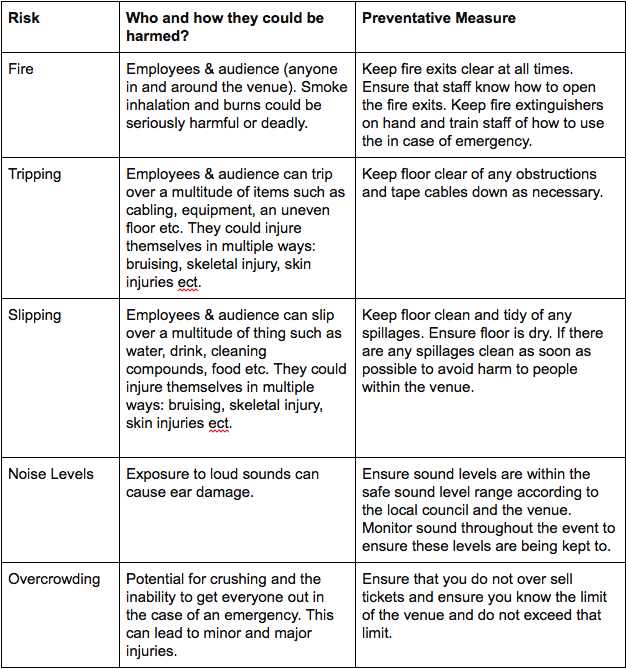
Examples of risks and their prevention
I have taken examples from a risk assessment form from Hse.gov.uk (2007, p.All), this risk assessment form focuses on a small outdoor event, however some of the risks apply to a small indoor event. To ensure I am maintaining and recording reliable information, I will be cross checking with another risk assessment form based on a small indoor event for a night club, again, this has risks that would be linked to a small indoor live event. Both of these sources are primary and reliable as they are from the Government’s official website, which holds all key information and laws that needs to be upheld.
Conclusion
Through educating myself on some of the common hazards within a small event, as well as how to prevent them, I am now able to confidently know what to do, to be able to encourage a safe event. I have also found out how to correctly document these risk assessments, as well as how important it is to have these safeguards in place in order to keep people safe and healthy. I will use this research to be able to make my own risk assessments that can be applied to the live music event that I am going to be organising.
The skills needed to be able to identify and record health and safety risks are all skills that I am familiar and comfortable with. Written communication skills are important when recording the risks and creating procedures for each risk. Spoken communication is also key, however, I feel that I need to develop these skills, the best way to do this is by practising it in a practical environment. In order to improve this skill, I will be communicating with people I am collaborating with to ensure they know about my health and safety plan. Organisation is also key to be able to put on a unified effort to prevent these risks from happening.
R
Reference Bibliography
Eventbrite UK Blog. (2017). Your Essential Guide to Health and Safety for Events – Eventbrite. [online] Available at: https://www.eventbrite.co.uk/blog/guide-health-and-safety-for-events-ds00/ [Accessed 14 Mar. 2019].
GOV.UK. (2019). Organising a voluntary event: a ‘can do’ guide. [online] Available at: https://www.gov.uk/government/publications/can-do-guide-for-organisers-of-voluntary-events/the-can-do-guide-to-organising-and-running-voluntary-and-community-events [Accessed 13 Mar. 2019].
Hse.gov.uk. (n.d.). Event safety – Planning for incidents and emergencies. [online] Available at: http://www.hse.gov.uk/event-safety/incidents-and-emergencies.htm [Accessed 14 Mar. 2019].
Hse.gov.uk. (n.d.). Event safety – Running an event safely. [online] Available at: http://www.hse.gov.uk/event-safety/running.htm [Accessed 13 Mar. 2019].
Hse.gov.uk. (n.d.). Manage the risks in your business. [online] Available at: http://www.hse.gov.uk/simple-health-safety/manage.htm [Accessed 14 Mar. 2019].
Hse.gov.uk, (2007). [PDF] HSE.gov.uk, p.All. Available at: http://www.hse.gov.uk/risk/casestudies/pdf/nightclub.pdf [Accessed 14 Mar. 2019].
GOV.UK (n.d) Event Safety Generic Risk assessment. [PDF] GOV.UK, p.All. Available at: http://www.mendip.gov.uk/chttphandler.ashx?id=2727&p=0 [Accessed 14 Mar. 2019].
 Alice's FMP